
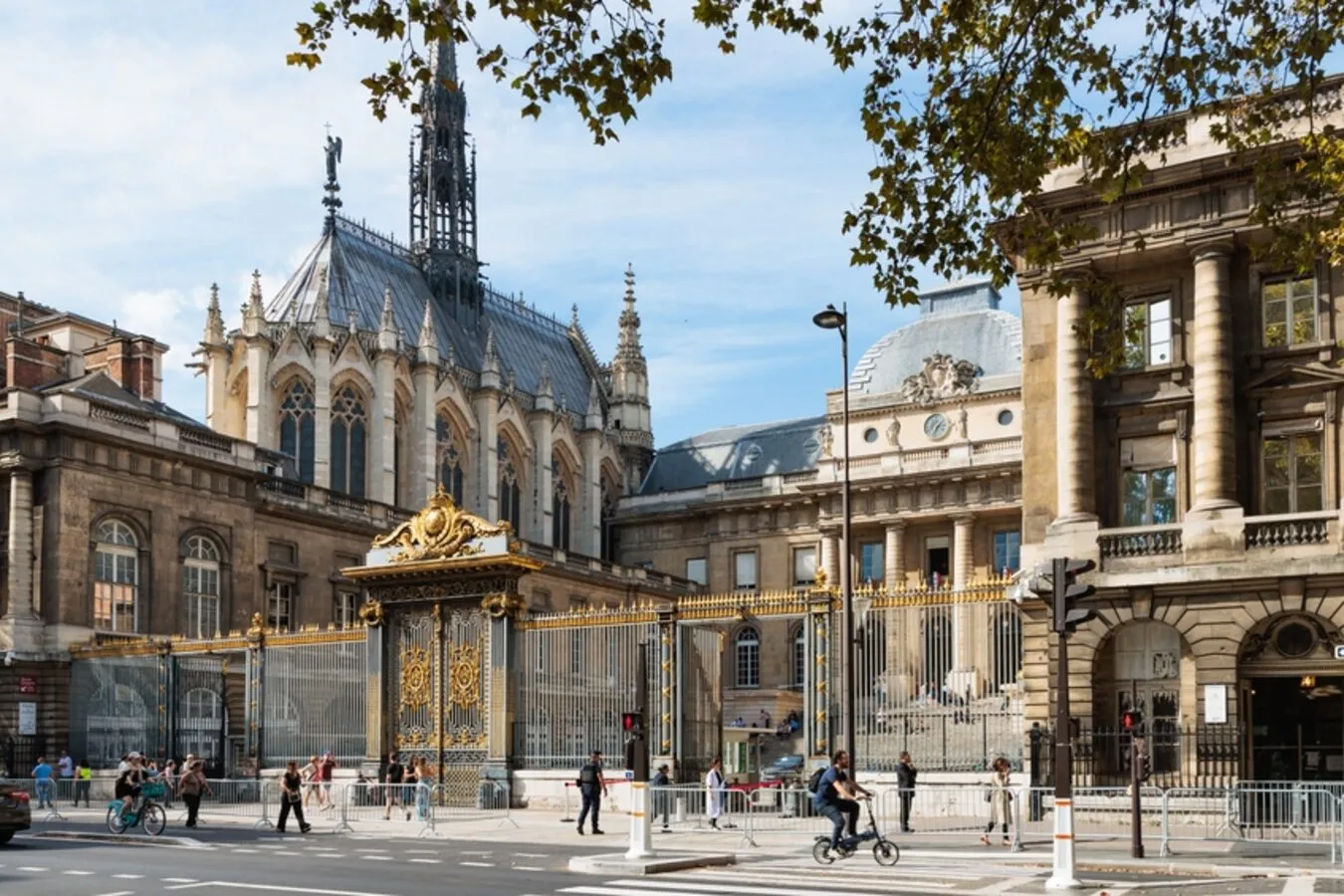
Why pair Notre-Dame with Sainte-Chapelle?
These two buildings embody the high point of French Gothic. Built a century apart on the same island, they tell complementary stories: Notre-Dame as the cathedral of the people of Paris; Sainte-Chapelle as the king’s private chapel.
Seeing them together helps you grasp how Gothic evolved — from the early and “classic” style of Notre-Dame (12th–13th centuries) to the radiant Gothic of Sainte-Chapelle, where stained glass becomes the main structural drama.
After the fire of April 2019, Notre-Dame reopened on 7 December 2024 following five years of extraordinary work. The cathedral has regained its full splendour, including a new spire faithful to Viollet-le-Duc’s design.
Two Gothic styles, two eras
Notre-Dame de Paris (1163–1345)
Begun under Bishop Maurice de Sully, Notre-Dame is a masterpiece of early and high Gothic. Construction stretched across nearly two centuries, which explains the subtle shifts in style you can still read in the fabric.
- West façade — The three sculpted portals and the Gallery of Kings
- The two towers — 69 metres high; access to the gargoyles
- The three rose windows — North, south and west, about 13 metres across
- Flying buttresses — The engineering that allowed walls to open up to glass
- The new spire — Rebuilt to match the pre-fire silhouette
Sainte-Chapelle (1242–1248)
Built a century after Notre-Dame, Sainte-Chapelle is radiant Gothic at its peak. Where Notre-Dame balances stone and glass, Sainte-Chapelle all but dissolves the wall into a cage of colour.
- 670 m² of stained glass — About two thirds are original 13th-century work
- 1,113 biblical scenes — From Genesis to the Apocalypse
- 15 bays about 15 metres high — Vertiginous for the period
- Light structure — Buttresses hidden from the interior view
- Restored polychromy — Painted decoration from 19th-century campaigns
How the combined tour usually runs
The semi-private guided visit covers both monuments in half a day. A typical flow:
In front of Notre-Dame, on the cathedral parvis. The guide hands out audio receivers so everyone can hear clearly.
Tour of the restored cathedral: nave, choir, rose windows, new installations. Commentary on the fire, restoration techniques and a thousand years of history on the site.
Short walk to Sainte-Chapelle with commentary along the way — often past place Louis Lépine (flower market) and the commercial court.
Lower chapel, then upper chapel: decoding the windows, Saint Louis and the relics, comparisons with Notre-Dame.
Time for photos. You are usually free to stay inside Sainte-Chapelle as long as you like within opening hours.
Comparing the two monuments
| Feature | Notre-Dame | Sainte-Chapelle |
|---|---|---|
| Construction | 1163–1345 (182 years) | 1242–1248 (6 years) |
| Style | Early / high Gothic | Radiant Gothic |
| Patron | Bishop of Paris | Saint Louis (king) |
| Function | Public cathedral | Royal palace chapel |
| Stained-glass area | ~1,000 m² | 670 m² |
| Admission | Nave free | Charged (€22 / €16) |
Planning your own day on the Île de la Cité
If you prefer to organise the visit yourself rather than join a combined guided tour, this is the rhythm I recommend:
Suggested itinerary
- 9:00 — Sainte-Chapelle at opening (fewer people)
- 10:30 — Coffee on place Dauphine or quai de l’Horloge
- 11:00 — Notre-Dame (allow time for any queue)
- 12:30 — Lunch in the Latin Quarter (five minutes on foot)
- 14:00 — Conciergerie (optional, next to Sainte-Chapelle)
- 15:30 — Walk the quays, perhaps Shakespeare & Company
Practical information
Getting there
Both monuments stand on the Île de la Cité. Common options:
- Métro — Line 4, Cité (mid-island)
- RER — Lines B and C, Saint-Michel – Notre-Dame
- Bus — Lines 21, 24, 27, 38, 47, 58, 70, 85, 96
If you buy tickets separately
- Notre-Dame nave — Free (open access)
- Notre-Dame towers — Online booking recommended when available
- Sainte-Chapelle — €22 (€16 EEA residents)
- Combined SC + Conciergerie — €30 (€23 EEA)
Frequently asked questions
Yes. You can buy a Sainte-Chapelle ticket and visit Notre-Dame’s nave (free) independently. The guided combo adds expert commentary and smoother timing between the two.
About five minutes on foot (400 metres). Both sit on the same island, linked by boulevard du Palais and rue de la Cité.
Access to the nave is free, like other French cathedrals. Towers and treasury may be charged and require booking. Since reopening, tower access rules are still being refined — check the official cathedral site before you go.
Notre-Dame is level at nave level. Sainte-Chapelle has a lift to the upper chapel. Both can be visited in a wheelchair, including the upper chapel.
My take on the combined tour
A good combined tour is still the clearest way to understand how these buildings speak to each other. The best guides show how Sainte-Chapelle “answers” Notre-Dame — and how Saint Louis aimed to outshine the cathedral with a chapel built for the crown.
If you are short on time or budget, put Sainte-Chapelle first: it is the more intense, more singular experience. Notre-Dame, magnificent as it is, belongs to a family of great Gothic cathedrals (Chartres, Reims, Amiens…). Sainte-Chapelle has no real twin.